


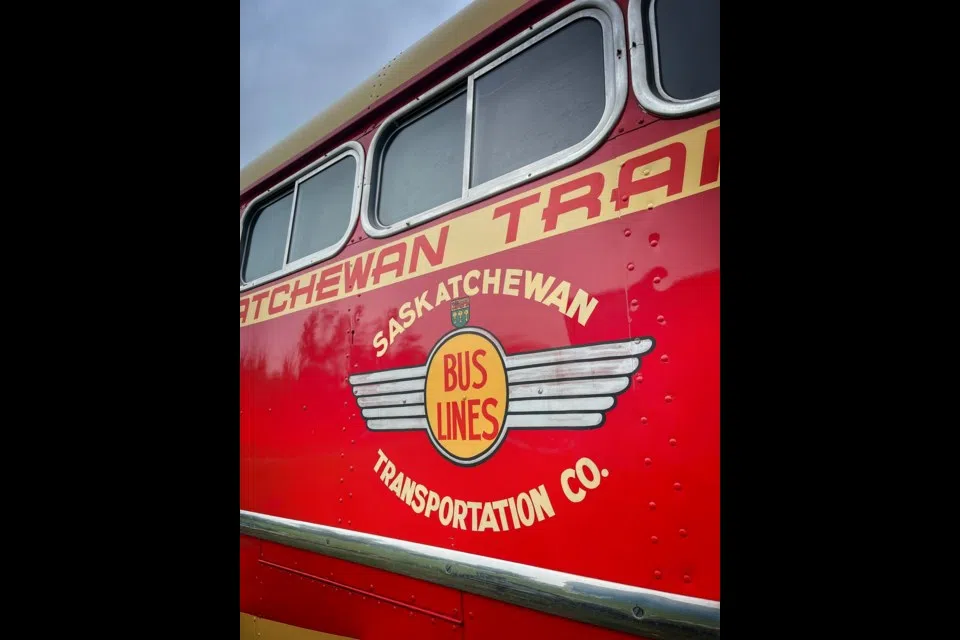
MOOSE JAW — The Western Development Museum (WDM) is bringing in three large vehicles to enhance its land transportation gallery, with two of the machines connected to Moose Jaw.
The WDM announced recently that it would close the building from Monday, Sept. 8, to Friday, Sept. 12, so it could safely transport and install a Saskatchewan Transportation Company (STC) intercity bus, a large ladder fire truck and a 4×4 Willys fire truck.
The organization received the STC bus in 2018 after the company shut down, while it has held the vehicle in storage at its corporate office in Saskatoon since then.
Meanwhile, the WDM has kept both fire trucks in storage in Moose Jaw for years. The organization noted that the Moose Jaw Fire Department used the ladder truck for in-city services — and in parades — while the former Valley View Centre used the Willys truck for rural and institutional fires.
In a news release, the WDM said these three vehicles reflect important aspects of Saskatchewan’s transportation and emergency response history. Furthermore, these vehicles will enhance the museum’s ability to share “more diverse and dynamic stories,” particularly about public transportation and emergency services.
To make space for these machines, the WDM said it deaccessioned several 1920s-era vehicles, which “is a normal and important aspect of museum practice,” the release continued. Deaccessioning allows institutions to “responsibly refine their collections” while aligning with “space limitations, interpretive priorities and long-term care considerations.”
The organization added that it followed the deaccessioning process using its collections development plan, which is on its website at wdm.ca.
The WDM Moose Jaw will reopen with regular hours on Saturday, Sept. 13.
“Our museum has a lot of really large artifacts… and … it’s pretty hard to move those around on a regular basis,” Karla Rasmussen, the WDM’s operations manager, said in an interview. “So when we have any sort of change coming into our gallery spaces, it’s going to be an exciting thing for sure.
“And the best part of this, I think, is that these pieces have been in storage and have not been available for the public to view in quite some time,” she continued.
The STC bus is “a beautiful thing,” while the ladder fire truck “is enormous,” is almost as big as the locomotive and has a sister truck at the Sukanen Ship Pioneer Village and Museum, Rasmussen noted. Also, the Willys truck was used to extinguish grass fires and is a “cool, little tough machine.”
Rasmussen said the machines are “really cool” and “aesthetically … pleasing,” since they’re from a relatively recent era that people remember. Conversely, few people remember using or seeing the 1920s-era cars.
The operations manager clarified that those cars are important and valuable, but the three new vehicles connect better with the demographics of visitors since the machines are mainly from the 1950s onward. Moreover, the fire trucks have that Moose Jaw connection, which is important.
Rasmussen said the WDM also possesses a third fire truck that was used in Mossbank and is on display in the aviation wing. So, she thought it would be great to have three firefighting vehicles present to showcase the evolution of emergency services.
With a chuckle, Rasmussen said staff have been “playing artifact Tetris” since the spring, figuring out how to position the vehicles in the gallery. However, the process was made easier by deaccessioning the older cars, which were transferred to other museums, put up for auction or sold to private collectors.
Continuing, she said moving out those vehicles allowed employees to revitalize some spaces and reorganize the collection, while summer visitors would have noticed a large open space near the observatory where the two fire trucks will be placed, with the STC bus positioned nearby.
Rasmussen added that the three new machines should encourage people to visit the WDM if they haven’t done so in years.
Visit wdm.ca for more information.





Comments