


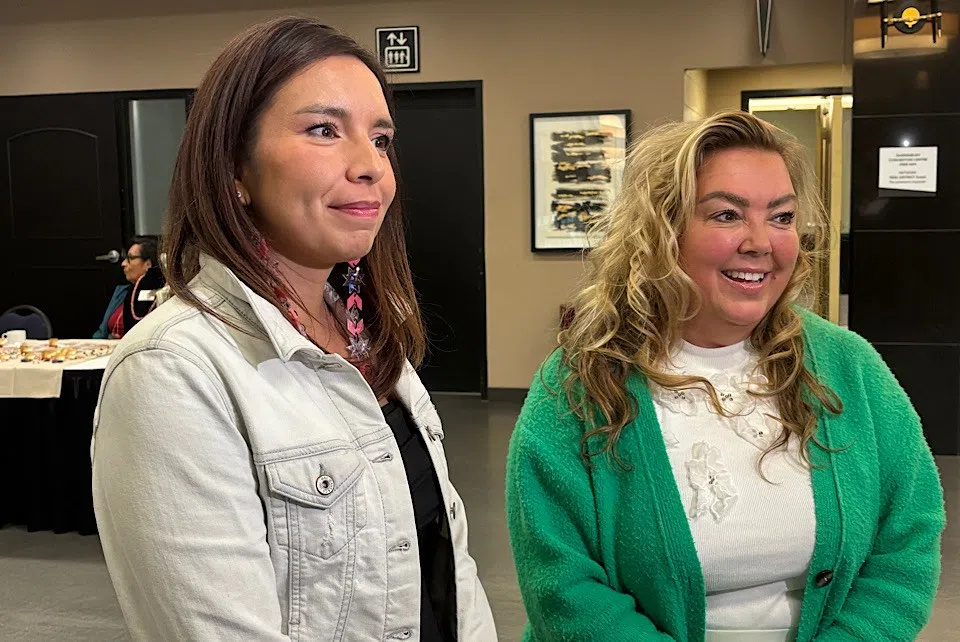
Finding ways to prevent and end homelessness, and in particular youth homelessness, was an important topic at the fifth annual Reaching Home Homelessness Conference in Regina.
The approximately 300 in attendance at the conference, presented by Namerind Housing Corporation of Regina, heard from two presenters from A Way Home Canada.
Kim Kakakaway and Heidi Walter are both with the organization, which Walter describes as “a national coalition that is focused directly on preventing and ending youth homelessness.”
“Kim and I were invited by Namerind here in Regina to be guest speakers here to share our experience and knowledge that we’ve had in ending and preventing youth homelessness.”
As for the solutions they are advocating for, Walter said that alongside the Canadian Observatory on Homelessness out of York University, they have had “close to a decade’s worth of opportunities, demonstration projects, to be able to test models like the Housing First for Youth program and the Family Natural Supports model. And we have data and research to be able to show that they are models that are truly preventing and ending youth homelessness in Canada. And so we’re really here to share our knowledge and our experience with the groups that are here today to be able to share how they could implement those in their own community.”
Kakakaway adds their focus is “on prevention, and so it is also looking at the school-based interventions” where they intervene before young people hit the streets.
Walter said they spend most of their time in communities “supporting organizations and supporting community entities and working alongside organizations to implement and to help them problem-solve and show up as a thinking partner around solutions to end youth homelessness… so Regina is one of those partners that we were happy to come here and support.”
One major issue they want to address is high rates of homelessness in the Indigenous community.
“Regina also has a high population of Indigenous people in general, and so that’s a big factor within the homelessness sector is high rates of Indigenous people experiencing homelessness,” said Kakakaway. “A lot of that is different reasons as to why. One of it is systemic issues, and so there’s a lot of racism and discrimination that’s still alive and well today that our people come up against. But there’s also just the colonial intergenerational trauma that also affects.”
She said her presentation was focused on “the history and the historical impacts of our Indigenous people, but also the impact of family and how family and community are important. And so that’s where our program model, also the family natural supports, is really important in the work that we do with especially our Indigenous people.”
When speaking about youth homelessness, Walter said they were looking at the age range between 13 to 25. She said this issue shows up in many different ways.
“We’re really focused on that prevention piece, and so we don’t want to see young people that have to get a label of chronic homelessness. We want to be able to prevent and end their experiences of homelessness as fast as we can.”
Walter said one focus of their presentation is that there is a misconception in Canada about why youth homelessness actually exists. She indicates it has more to do with what goes on inside the home.
“77 per cent of young people who have left home or had to leave home, whatever those reasons are, actually is because of family conflict,” said Walter.
“So we don’t start at a place of housing. We start at a place of what’s going on that we can help prevent young people having to leave. If young people do have to leave, what does relationships look like with family, chosen family, natural supports, adopted family, whoever that might be? And so housing is definitely something that is important, but we want to take that further upstream to figure out what are the root causes and how can we prevent it before young people are having to access housing on their own at the age of 16.”
Kakakaway said another factor is the child welfare system and transitioning out of the child welfare system into adulthood, and a lack of funding for that. “So it’s so layered with some of those contributing factors. It’s in-home family conflict. It’s child welfare programs. It’s just lack of supports.”
Walter was also asked about why more people are advocating for affordable housing as opposed to shelters. She replied it was because “shelters are not home. You can’t stabilize in shelters and we shouldn’t expect any human or individual to stabilize in shelter. If any person has ever been in a shelter, it is not some place that you can necessarily always feel safe and start to heal…”
“And so it’s why the Housing First and the Housing First for Youth models exist, is that it’s ‘housing, first’ and then the wraparound supports without time limits. And so while shelters and emergency services may be important, I believe that we need to be focusing our energy and our funds into prevention and housing and supports and less into emergency supports.”




Comments