


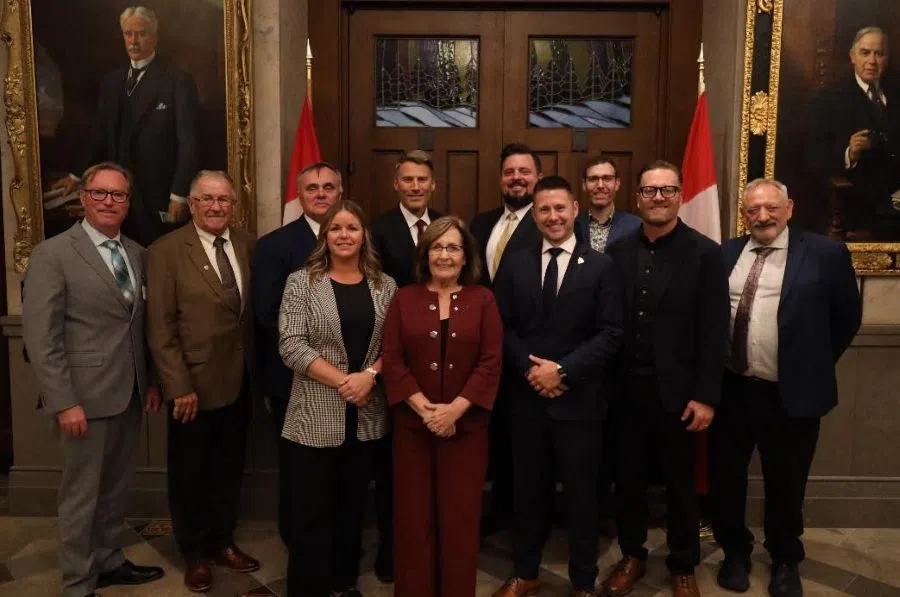
Mayor Aaron Kienle says that his recent trip to Ottawa highlighted the need for federal infrastructure funding to support communities like Yorkton.
Kienle was among a delegation of provincial and municipal leaders who travelled to the nation’s capital to meet with federal officials regarding a new infrastructure funding model to replace the Investing in Canada Infrastructure Program (ICIP), which expired earlier this year.
The two-day trip included meetings with several federal ministers and staff, including Minister of Housing and Infrastructure Gregor Robertson, Minister for Prairies Economic Development Canada Eleanor Olszewski, Secretary of State Buckley Belanger and members of the Saskatchewan Conservative caucus and Senate.
The delegation also included Government Relations Minister Eric Schmalz, Advanced Education Minister Ken Cheveldayoff and the mayors of Regina, Saskatoon, Moose Jaw, Prince Albert, Swift Current, North Battleford and Yorkton. Representatives from the Saskatchewan Association of Rural Municipalities (SARM) and the Saskatchewan Urban Municipalities Association (SUMA) also joined the discussions.
Kienle says the meetings were focused, constructive and highlighted a shared recognition that municipalities across the country are facing mounting infrastructure challenges with limited fiscal tools to address them.
“The conversations were very positive,” Kienle said. “There was a clear understanding from federal officials that communities like Yorkton — and others across Saskatchewan — need a new, sustainable funding model to keep up with growth and comply with new regulations.”
Kienle says one of Yorkton’s top priorities remains its aging wastewater treatment plant, which is currently operating at capacity. With local growth and new industrial developments, including a planned canola crushing expansion, the system is nearing its limit.
The facility also falls short of newer environmental and regulatory standards set by both provincial and federal governments.
“We’re not in a position where we can delay,” Kienle said. “We’ve already invested $1 million to get 30 per cent of the planning and engineering work done. That gives us a clear picture of the dollars needed to make this happen.”
He added that the cost of building a new facility has risen dramatically, and Yorkton cannot shoulder the full financial burden alone.
“Municipalities can’t run deficits,” Kienle said. “When the federal or provincial governments identify a need, they can borrow or adjust budgets. We can’t do that. We rely on funding partnerships and programs like ICIP to make large projects possible.”
The city’s wastewater project has already been submitted twice for federal consideration but was turned down under the previous program — partly because it wasn’t “shovel-ready” at the time. Now, Kienle says, that’s no longer the case.
“We’re ready to move,” he said. “We have the design work done and the case made. What we need now is a funding program that allows us to act.”
During meetings in Ottawa, Kienle and other Saskatchewan delegates emphasized the need for a permanent federal infrastructure program — one that offers predictable, long-term funding and allows municipalities to plan effectively.
The now-expired ICIP model, officially known as the Investing in Canada Infrastructure Program, was widely credited with helping smaller communities complete projects that would have been out of reach otherwise.
Yorkton, for example, utilized ICIP support to transform its pathway network, replacing gravel and grass routes with kilometres of paved trails that now link neighbourhoods across the city.
“That program was instrumental,” Kienle said. “It gave us the ability to improve our quality of life in ways that would’ve taken decades without that partnership.”
He said there was a broad consensus among both federal and provincial officials that the ICIP framework was effective and could be quickly adapted into a new national program.
“The bones of ICIP are still there,” Kienle said. “It worked. What we need now is to renew and build on that structure rather than starting from scratch.”
Kienle said the unified presence of Saskatchewan’s eight largest cities — alongside SUMA and SARM — made an impact in Ottawa.
“It showed that we’re all on the same page,” he said. “From the largest cities like Saskatoon and Regina to the smallest rural municipalities, we share the same challenges: we need sustainable funding and long-term certainty.”
Federal officials, he noted, responded positively to that approach.
“They told us this is exactly what they want to see — mayors, ministers, and rural leaders coming together with a common message,” Kienle said. “We showcased our province well.”
One key takeaway, Kienle added, was the importance of continued advocacy. Federal ministers acknowledged that Saskatchewan municipalities are underrepresented in Ottawa compared to other regions.
“Minister Robertson, who used to be the mayor of Vancouver, told us that he always saw delegations from the Maritimes and Ontario, but rarely from Saskatchewan,” Kienle said. “He encouraged us to come more often — to keep that presence up.”
Kienle agreed, saying Saskatchewan communities have a reputation for self-reliance that sometimes keeps them from pushing their case on Parliament Hill.
“We tend to roll up our sleeves and get the job done,” he said. “But sometimes we need to remind Ottawa that we’re here, that we have pressing needs, and that federal investment in Saskatchewan communities pays dividends across the country.”
While the fall federal budget is not expected to introduce any new infrastructure funding, Kienle says there’s optimism that the spring budget could include new funding opportunities.
“We know the immediate timeline is tight,” he said. “But the message we heard is that there’s openness to a renewed program — possibly as early as spring. That’s encouraging.”
He emphasized that these kinds of investments are not about short-term wins, but about long-term sustainability for Yorkton and the entire Parkland region.
“This isn’t just about a treatment plant,” he said. “It’s about ensuring we can keep growing responsibly, attract investment, and protect our environment for the next generation.”
Kienle says a federal partnership will be the key to ensuring they can meet that growth sustainably.
“We’re optimistic,” he said. “We left Ottawa knowing our message was heard — now we just need to see it reflected in the next budget.”





Comments