


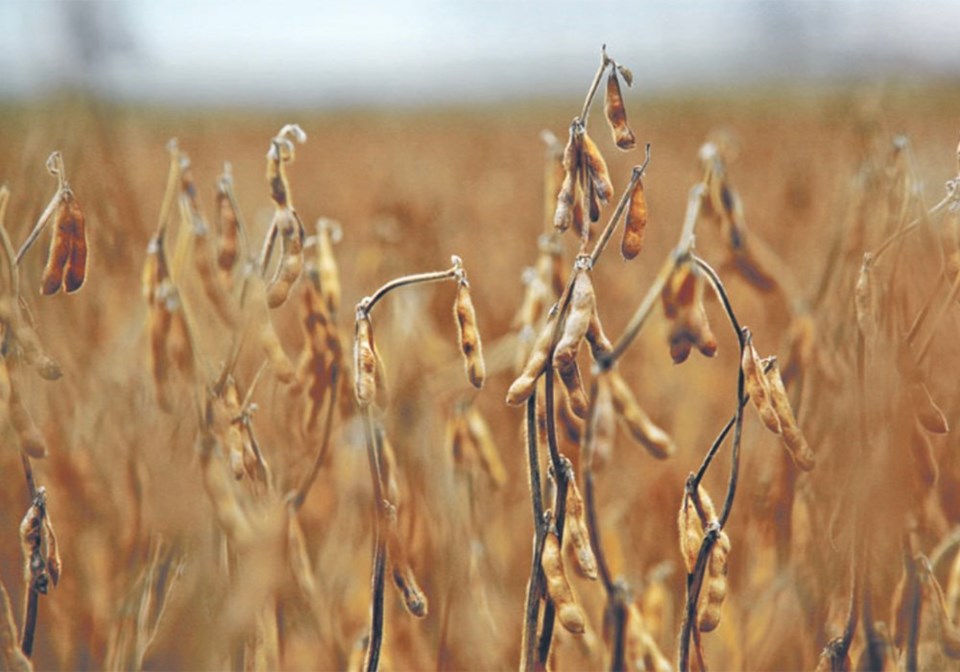
More fields are looking empty as harvest progress in Saskatchewan is 93 per cent complete, up from 84 per cent last week.
Almost all of the winter cereals and pulse crops are completely harvested. For crops left standing, chickpeas are 70 per cent combined, spring wheat and barley are 98 per cent harvested, durum and oats are 96 per cent complete, and 91 per cent of mustard, 89 per cent of canola, 70 per cent soybeans, and 60 per cent of flax are off the field.
Every region is above 90 per cent complete. The west-central jumped ahead of the southwest at 96 per cent complete, the southwest and northwest are 95 per cent complete, the east-central and northeast are 93 per cent done, and the southeast is 92 per cent complete.
Crop damage is becoming less of a concern at this point but "wind continues to blow swathes around, wildlife is feeding on crops and freezing temperatures are impacting crops." Damage overall is minor and not widespread.
Updated crop yields remain above average with some variability due to different rainfall amounts and weather conditions, similar to last month.
Provincially, the report has "hard red spring wheat yielded 51 bushels per acre, durum yielded 41 bushels per acre, oats yielded 92 bushels per acre, and barley yielded 71 bushels per acre. For pulse crops, field peas yielded 42 bushels per acre, lentils yielded 1,922 pounds per acre and chickpeas yielded 1,817 pounds per acre. Notable amounts of oilseed crops are still being combined, but canola is currently yielding 42 bushels per acre, mustard is yielding 1,192 pounds per acre and flax is yielding 26 bushels per acre."
Wheat grades were also updated with variability due to the same factors.
The crop report states, "provincially, 65 per cent of hard red spring wheat is 1 Canada Western (CW), 27 per cent is 2 CW, six per cent is 3 CW and only two per cent graded as CW Feed. Average quality this year is better than historical averages. The five-year average hard red spring wheat quality is 62 per cent 1 CW, 30 per cent 2 CW, six per cent 3 CW and two per cent CW Feed. The 10-year average hard red spring wheat quality is 48 per cent 1 CW, 32 per cent 2 CW, 13 per cent 3 CW and 7 per cent CW Feed."
Persistent dry conditions resulted in a decline of topsoil moisture for crop land, hay land, and pasture land.
"In cropland, topsoil moisture is one per cent surplus, 43 per cent adequate, 40 per cent short and 16 per cent very short. In hayland areas topsoil moisture is two per cent surplus, 38 per cent adequate, 40 per cent short and 20 per cent very short. In pastures, topsoil moisture is one per cent surplus, 28 per cent adequate, 45 per cent short and 26 per cent very short." reads the report.
The most rain fell in the North Battleford and Wapella areas with 25 millimetres (mm), followed by the Whitebeech area with 20 mm, the Wishart area 17 mm and the Norquay and Foam Lake areas had 16 mm.
As harvest operations wrap up, producers are spraying for weeds, harrowing, applying fertilizer and moving livestock.
Farmers who are still combining are reminded to have fire extinguishers and water trucks at the ready in case of a fire and to take precautions around power lines. The public is also reminded to be patient and cautious around large equipment when on the road.