


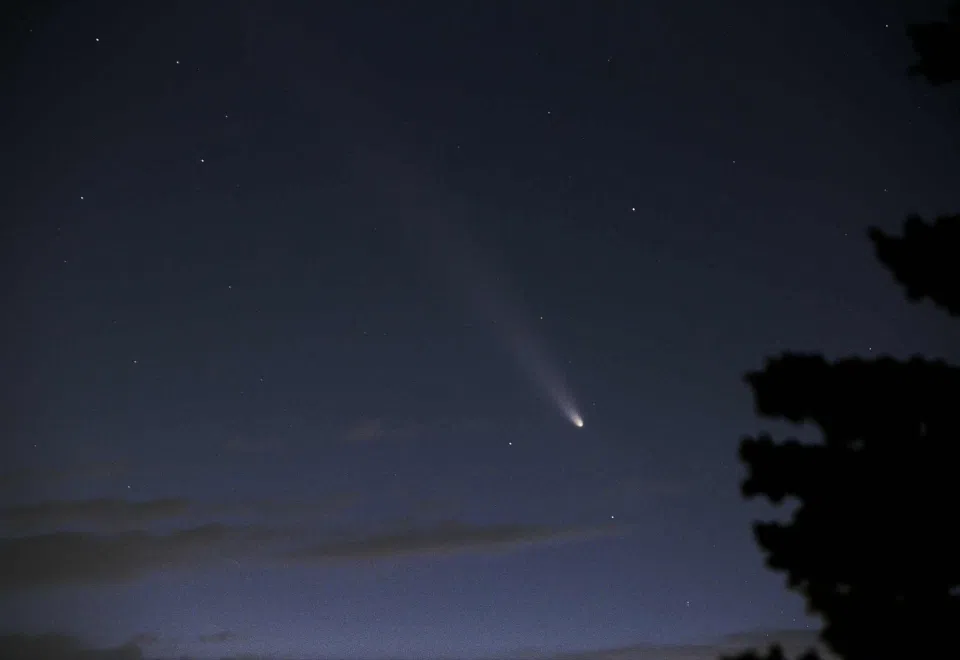
REGINA — Stargazers in southern Saskatchewan are in for a rare celestial event this month as Comet Lemmon (C/2025 A6) makes its closest approach to Earth in roughly a thousand years.
The glowing green comet will reach its nearest point on Oct. 21 and could be visible to the naked eye from dark-sky areas outside Regina, depending on weather and light conditions. Astronomers say Lemmon’s distinctive hue comes from diatomic carbon, a molecule that glows green when it reacts with sunlight in the vacuum of space.
The comet has been brightening through early October and is expected to reach a magnitude of about +4 near the end of the month, bright enough to glimpse without binoculars under clear skies. Observers in Regina will have the best viewing opportunities in the pre-dawn hours through mid-October, looking toward the northern and northeastern horizon near the Big Dipper and the constellation Canes Venatici.
Around Oct. 16, Lemmon will pass within one degree of the bright star Cor Caroli, providing a helpful reference point for locating it. As the comet swings closer to the Sun, it will shift into the evening sky, making it possible, though more challenging, to spot just after sunset in late October.
“If you can find a dark spot with a clear view north and northeast, and get out before dawn around 4:30 or 5 a.m., you’ll see one of the most beautiful comets in years,” said Richard Covey, an astrophotographer and member of the Royal Astronomical Society of Canada. “The green glow is subtle to the eye but spectacular through a camera or telescope.”
While Regina’s light pollution makes urban viewing difficult, nearby sites such as Wascana Trails offer relatively darker skies. Saskatchewan’s dark-sky preserves, including Grasslands National Park and Cypress Hills Interprovincial Park, provide ideal conditions for long-exposure photography or extended viewing sessions.
Covey said mid-October offers the best window for viewing, with the comet nearing peak brightness around Oct. 20. “After that, you can try watching just after sunset, though it will be lower on the horizon and trickier to spot in the city’s glow,” he said.
Astronomers recommend dressing warmly and allowing eyes at least 15 minutes to adjust to the dark. October mornings can dip below freezing, so gloves, a thermos and a reclining chair can make the experience more comfortable.
For photographers, Covey suggests long exposures of 10 to 30 seconds to capture Lemmon’s faint tail. If skies stay clear through late October, the comet may become one of the most photogenic to visit Prairie skies in recent decades.
“Comets with orbits this long are time travellers from the edge of the solar system,” Covey said. “Seeing one like this is a reminder of how dynamic and beautiful our skies really are.”





Comments