


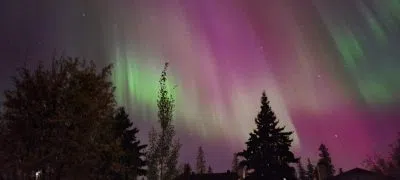
REGINA — A massive coronal mass ejection has ignited brilliant northern lights across Canada and deep into the southern United States in one of the strongest geomagnetic storms of the current solar cycle.
Space weather agencies say at least two Earth-directed CMEs arrived Tuesday carrying dense plasma and magnetic fields far stronger than normal. The storm reached G4 intensity on the U.S. National Oceanic and Atmospheric Administration scale and produced vivid auroras from Saskatchewan and Manitoba to as far south as Texas and Florida.
Forecasters say more activity is expected. Additional solar eruptions still moving toward Earth could extend the display through Wednesday and Thursday nights, with Saskatchewan among the regions most likely to see repeated shows.
Richard Covey, a member of the Royal Astronomical Society of Canada and a solar photographer based in southern Saskatchewan, says residents in the province are in an ideal position.
“This storm is unusually strong and it is not finished,” Covey said. “If skies clear over Regina or anywhere across the Prairies, you could see another spectacular burst of colour.”
He says multiple CMEs striking Earth within a short period often create several nights of activity.
“When these eruptions pile up, the magnetic field stays unsettled,” he said. “That is when Saskatchewan gets those big curtain-style auroras that stretch right overhead.”
The latest storm comes as the sun approaches the peak of its 11-year cycle. Past events have had dramatic effects. The 1859 Carrington Event produced auroras as far south as Hawaii and damaged telegraph systems. A severe storm in 1989 knocked out power across parts of Quebec.
Scientists warn that today’s reliance on satellites, GPS and digital infrastructure makes modern systems more vulnerable to extreme solar weather.
For now, forecasters say the main impact for Saskatchewan is the strong chance of seeing the aurora again over the next few nights, provided cloud cover stays away.





Comments