

REGINA — Cpl. Jamie Diemert, co-ordinator of the Saskatchewan RCMP Underwater Recovery Team (URT), reminds the public to be careful on the ice and around water this time of year.
“Winter is coming very slowly this year. Lakes, rivers, sloughs, ponds and dugouts are slowly freezing on the surface, but there is still warm water below the surface. This creates weak ice that is unsafe. It can break under the weight of a single person. Please take ice very seriously. If you fall in, it is very difficult to get out of cold water while the ice is breaking around you. There is a high risk of drowning.”
Here are Diemert’s ice safety tips:
- In early season, as the ice conditions are not stable, do not walk, play, work or drive on the ice.
- Do not walk on white or snow ice. It is the weakest type of ice. Because white ice traps air and snow while freezing, it is not strong and can break under the weigh of a single person. It will form when temperatures are close to 0 C. This is the type of ice appearing these days across Saskatchewan and it is not safe.
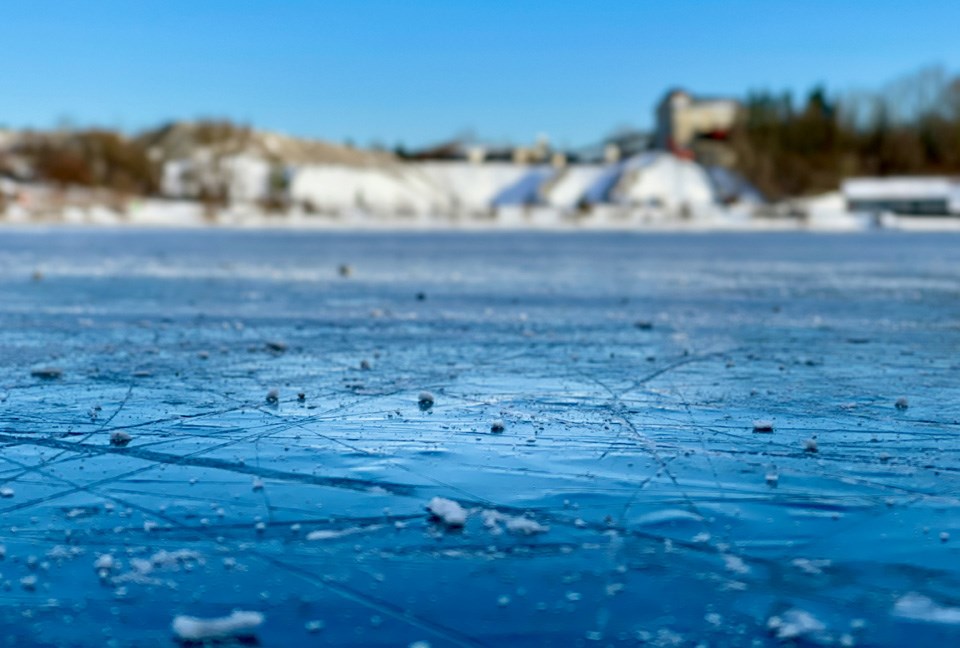
- Wait for clear strong and stable ice to form before getting onto the ice. Clear ice, often appearing blue, is the strongest type of ice. It will form only when temperatures have been consistently below zero for a long time. Clear blue ice is safe only when it is of a certain thickness. The Canadian Red Cross recommends a minimum of:
- 15 centimetres for skating, walking or skiing in small groups;
- 20 cm for larger groups, such as skating parties; and
- 25 cm for snowmobiles or ATVs.
- If, for any reason, you must be on the ice, use a Personal Flotation Device (PFD) and have self-rescue ice picks ready to be used.
- If you fall in the water, call for help. Do not press on the ice near you to raise yourself up. Instead, swim out of the water horizontally and kick your legs to propel yourself out of the water. Once out the water, don't stand up. Instead, crawl or roll away from the area, spreading your arms and legs to evenly distribute your body weight.
- If you witness someone on thin ice who needs help, immediately call 911. The best way to safely help a person is from the shore, or there is a high risk you could end up in the water yourself. Extend your reach with a long pole or throw the end of a rope at the person in need.
- Consider other factors that can weaken ice that looks safe. Cracks in the ice, recent air temperatures fluctuating above and below zero Celsius, moving water under the ice, and the presence of storm sewers that bring salt from nearby roads can all make the ice unsafe.
The Underwater Recovery Team (URT) is a specialized service offered by Saskatchewan RCMP Operational Support Services. URT assists with a wide variety of police operations that require underwater investigation, including missing persons, evidence retrieval and search and recovery.