


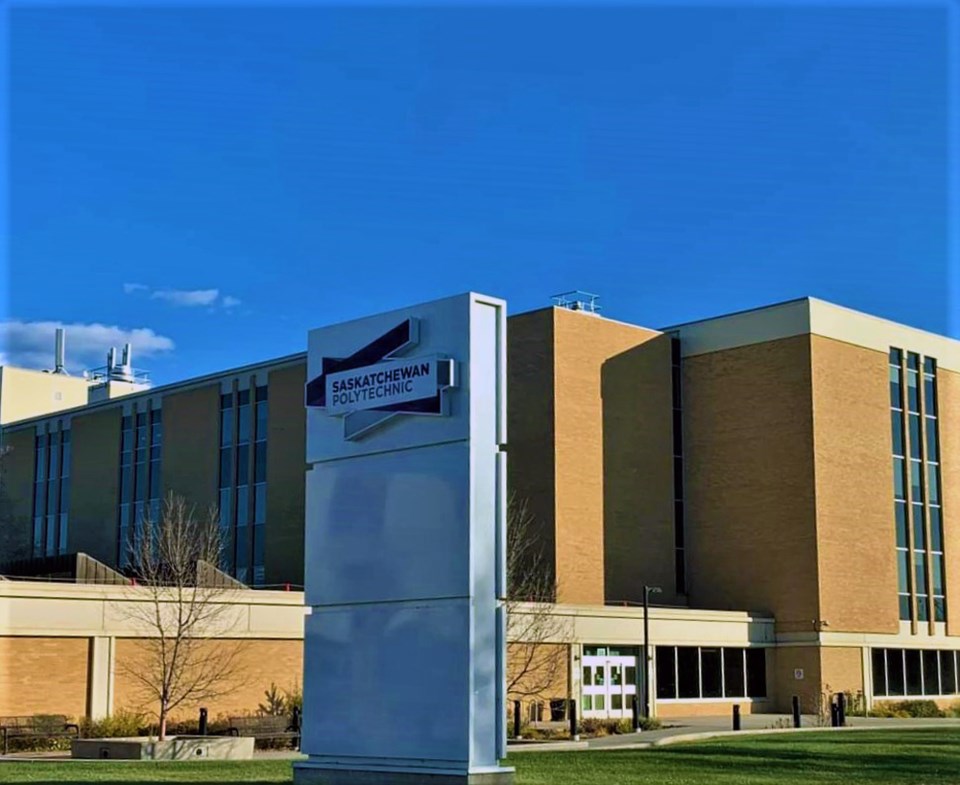
SASKATOON — Timothy Carlow and Alex Loewan are unsure of what their respective professional careers might be, as both face an uncertain future after Saskatchewan Polytechnic decided to suspend the Electronic Systems Engineering Technology program in preparation for its relocation to Regina.
Carlow and Loewan shared their sentiments with members of the local media during a press conference by Saskatchewan NDP Trade & Export Development Shadow Minister Kim Breckner on Thursday, Feb. 12, at the opposition’s office on 22nd Street West.
The office of the Technology & Skilled Trades Faculty Dean, Brenda Suru, sent an email to inform ESET students of the suspension of intake for the first year of the Fall 2026-2027 program, as part of the changes they will implement next year.
“As an ESET student, your program will continue in its original format for Year 2 with one significant change. In Fall 2026-27, ESET will relocate from our Saskatoon campus to our Regina campus, joining the Faculty of Digital Innovation, Arts & Sciences. This move will allow us to operate more efficiently and create space for new innovation-focused centres that will enhance learning opportunities for future students,” said the letter.
Carlow and Loewan are among the 21 students taking the ESET program who would be affected by the move, who sent a letter to Premier Scott Moe, specifically saying that the relocation, which was done without consultation with students and faculty, would force many students to withdraw from the program due to financial and family reasons.
Carlow added that although he does not know the total number of students affected by the decision, about 15 students in his and Loewan’s class need to decide whether to continue in the ESET program or withdraw from it.
Both said their dream was to finish the program in Saskatoon and were looking forward to a career in companies that need personnel for automated systems, radio communications for airplanes, and satellite communications. Completing the ESET program was their fallback, especially for Carlow, who is still recovering after an injury in his previous job as an auto mechanic.
“I had an injury at work. So, I am funded by workers’ compensation. For me, I won’t likely be able to go to Regina. It’s going to have a greater impact on my personal relationships. Whereas other students are trying to figure out how to afford the move,I can’t fall back on that field [auto mechanic]. This [ESET program] is the best alternative for me. So, I don’t have any other ideas at this time,” added Carlow.
Loewan, who has two kids and a wife with her own career in the city, said he will be forced to discontinue his education, wasting the work he has put into earning the ESET certification.
“The work that I had put towards the [ESET] certification will be erased. There wouldn’t be anything to show for it professionally. I wouldn’t be certified with only my first year. So, I would be starting from scratch,” added Loewan, who had little time spent with his family as he used the weekends to study.
Disrupting students’ lives
Breckner blamed the provincial government for what is happening to Saskatchewan Polytechnic, citing recent job cuts and now the decision to move the program to Regina, which lacks consultation with those affected. She added that the decision is disrupting students’ lives and undermining confidence in the postsecondary system.
The relocation means dozens of students must move to Regina to complete their program. Breckner said the decision has left many scrambling to secure housing, financial support and child-care arrangements with little notice.
“Dozens of students are being forced to up and move because of Scott Moe’s failure to fund our postsecondary sector properly. This means that students are now scrambling to sort out financial assistance and family arrangements without warning. This is not how a healthy postsecondary sector or a competent government should function,” said Breckner.
“These students are our future. Instead, they’re being forced away from their homes and families because this government fails to fund postsecondary education properly. This is not how a healthy postsecondary sector, or a competent government, should function. For faculty, this is not normal. It’s not right.”
Breckner said, arguing that the move sends a message that the government is not considering the real-world impact of its policies, adding that the consequences extend beyond individual students, affecting teachers, Saskatchewan Polytechnic, and the province’s future competitiveness.
Autonomous institution
The Ministry of Advanced Education, in a statement, said Saskatchewan Polytechnic and other post-secondary institutions across the province operate autonomously, making their own decisions on staffing and program changes.
“These operational matters are not directed by the Government of Saskatchewan or the Ministry of Advanced Education,” said the statement.
The Ministry of Advanced Education added that the provincial government is fully committed to keeping its post-secondary education sector strong and sustainable, to give students opportunities to learn closer to their homes and communities.
“We recently announced a new multi-year funding agreement that will provide approximately $250 million in additional operating funding to post-secondary institutions over the next four years, beginning April 1, 2026. The agreement guarantees annual funding increases of three per cent,” said the statement.
“This approach gives institutions stability and greater funding certainty. While it will not fully offset the impacts of national and global pressures, it will support institutions in continuing to deliver high‑quality education and training that aligns with Saskatchewan’s labour market needs.”