


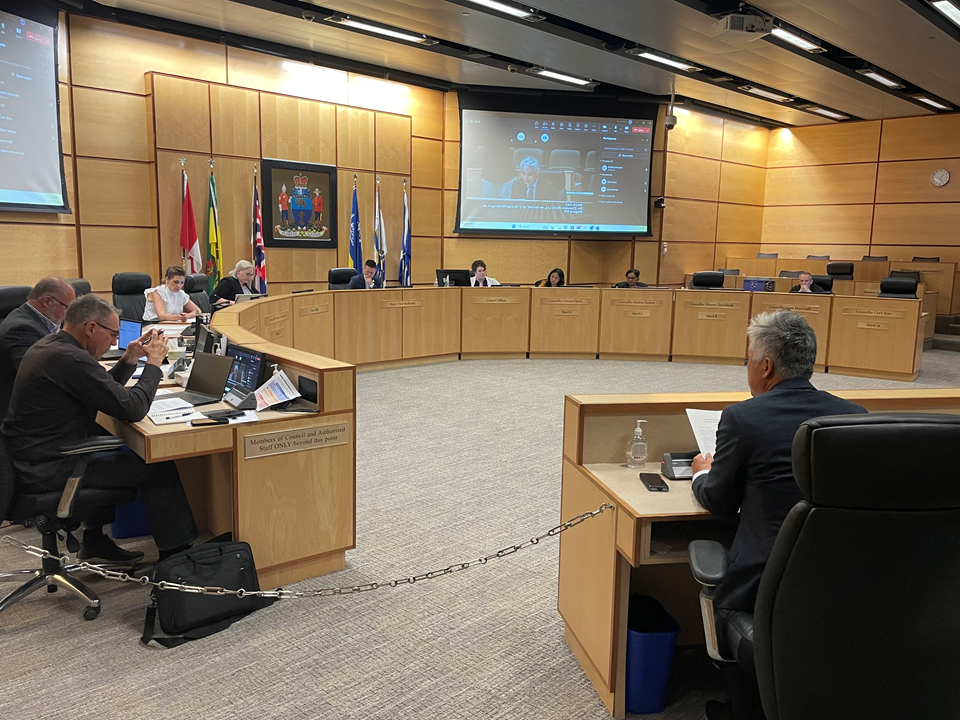
REGINA — The City of Regina has passed the latest official community plan (OCP) during Wednesday’s city council meeting in a unanimous vote.
The OCP was first introduced in 2013, created to support a population of 300,000.
The updated plan, developed over the past two years, factors in the city’s projected population of 370,000 by 2051, along with the addition of 68,200 jobs and 56,900 new housing units.
A key policy change in the new plan divides neighbourhoods based on available infrastructure, primarily wastewater capacity.
Short-term tier 1 includes Westerra, Hawkstone and Somerset. Tier 2 incorporates Rosetown, Westbrook and Coopertown (south of Rosetown), while Tier 3 has the area north of Maple Ridge, Coopertown (north of Rosetown) and Skywood.
Earlier, Skywood developers pushed for council to move the neighbourhood from short-term Phase 1 to short-term Phase 1.
In a previous meeting, Evan Hunchak of Bright Communities said Skywood could lose 90 per cent of its land assessment value (from $31 to $3 million) as developers expect an additional wait time of 30 years.
Hunchak mentioned wanting a fair distribution of wastewater capacity with other developments beginning in the area during the 2010s, including Hawkstone, Somerset, and Kensington Greens.
“Why can’t we have a little stint as well as it relates to capacity allocation?”
Hunchak has previously floated the idea of utilizing the Rochdale trunk with natural drainage, but administration said there isn’t enough capacity to add Skywood.
He also floated the idea of utilizing in-line storage to move wastewater in the city’s system during non-busy hours.
Kurtis Doney, deputy city manager of city operations, explained the implications this would cause for the city.
“It’s going to need to be cleaned much more regularly than a normal pipe. So that increases our operational cost significantly,” he added.
Deborah Bryden, deputy city manager of city planning and community, believes Skywood is better positioned under the new plan and could access wastewater services within five to seven years if it opts to help fund the Northwest Regional Wastewater Lift Station (NRWLS).
“They can contribute to the lift station [and] they can front-end the trunk past Rosewood, I would say to advance that work.”
Missing pieces of OCP?
Harbour Landing West Developments believed the OCP should include measured flexibility.
“Allowing measured flexibility ensures the city can respond to market changes and project-specific constraints without compromising long-term planning,” said Darryl Lucke, Harbour Landing West Developments.
Lucke said that flexibility could mean Regina receives additional federal funding to strengthen and expand its housing capacity.
“Right now, if you want to move to Regina, you have two choices, northwest or southeast.”
Harbour Landing West Developments believes the move would also show Regina is open for business.
Another delegate, University of Regina Associate Professor in Geography & Environmental Studies, Vanessa Mathews, believed the updated OCP should include a set target for intensification in Regina’s downtown.
“We want to indicate that we want the downtown to be a vital and engaged part of our community.”
The last version of the OCP had a set target of 10,000 new residents in the City Centre.
City administration explained the change was due to difficulty tracking the exact number of people in the area.
Mathews noted the area has struggled to attract people, losing 36 per cent of its population in the 2021 census.
She expects the 2025 census to show slight progress.
Mathews also urged Regina needs to showcase housing downtown, as future residents know they have more options besides the outskirts.
Council’s comments
Mayor Chad Bachynski said the newest OCP creates certainty for the community.
“This takes the entire community into consideration and not just one developer.”
Bachynski also said he didn’t hear any developer say this plan is bad.
Ward 6 Coun. Victoria Flores mentioned the importance of collaboration and careful planning, adding, “If we can focus on your resources and best practices, we can grow our community in a thoughtful way.”
Council will receive a renewal cycle for the OCP five years from now.