OTTAWA — A Federal Court judge has ruled that a Saskatchewan Penitentiary officer used unjustified force on inmate Kelsey Stewart during a 2020 cell search, ordering the Canadian government to pay him $65,000 in damages.
Justice William F. Pentney ruled that Correctional Officer (CO) Anderson used “unprovoked and unjustified” force against Stewart on the morning of Feb. 4, 2020, causing a gash over his right eye that required six stitches, significant swelling to the left side of his face, and temporary blurred vision.
In his 71-page April 16 written decision, Justice Pentney wrote directly to Stewart, saying, “CO Anderson had no good reason to slam you against the cell door so hard.
“He is much bigger than you, and you had your back to him with your hands up by your head,” added Justice Pentney. “You started to lower your hands and put them behind your back, so when he pushed you against the cell door you had no way to protect your face from hitting the bars on the door. At that point you did not look threatening in any way; you were still facing the back of your cell and the guards were behind you.”
The Attorney General of Canada (AGC), acting on behalf of Correctional Service Canada (CSC) admitted the force was disproportionate but argued for $5,000 to $15,000.
Internal CSC reviews initially backed the correctional officer, but a 2023 national grievance decision found the video didn’t support the officer’s accounts that the use of force was justified.
A second camera and a medical recording captured cuts, abrasions and swelling on both sides of Stewart’s face. The judge found the additional left-side injuries were caused by further force applied after Stewart was pinned.
The incident
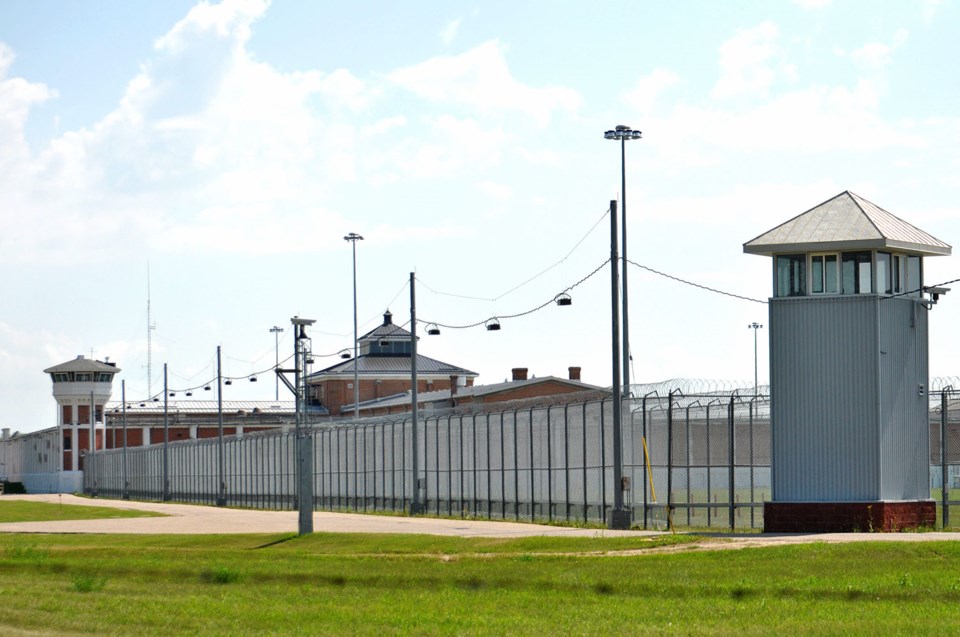
The incident happened inside Saskatchewan Penitentiary's medium-security unit, a federal prison located about one kilometre west of Prince Albert. According to court documents, three correctional officers approached Stewart’s cell to conduct a monthly search. Stewart, who was asleep, initially resisted verbally but later physically complied. He began backing out of his cell with his hands behind his head as instructed.
Video evidence, which the judge described as key to his findings, shows that as Stewart reached the doorway, CO Anderson suddenly grabbed him and forcefully pushed him face-first into the metal bars of the cell door. Stewart’s hands were behind his back at that moment, leaving him unable to protect his face.
Statements made by COs Hawkes and Boka backing CO Anderson were discredited. The officers claimed that Stewart had “turned aggressively” toward CO Anderson, provoking the use of force. But Justice Pentney found that claim was “flatly contradicted by the video evidence” and described it as “perpendicular to reality.”
The judge also pointed out CO Anderson didn’t testify at trial, leaving only his written reports, which the judge described as “self-serving” meant to justify his actions, and lacking in credibility.
“CO Anderson has consistently refused to take responsibility for his actions, which weakens the force of his explanations,” said Justice Pentney.
Damages awarded
The Government of Canada was ordered to pay Stewart $50,000 in compensatory damages for battery, saying that the assault was “completely unprovoked” and occurred while Stewart was in a “vulnerable position.”
An additional $15,000 was awarded for the violation of Stewart’s section 7 Charter right to security of the person. Justice Pentney said this “vindication” award was necessary to underline the importance of Charter rights, particularly in prison context where inmates are highly vulnerable to abuses of authority.
They were also ordered to pay Stewart’s court costs of $9,000 and disbursements totalling $1,246.
The judge rejected Stewart’s request for a much larger award of $240,000, finding insufficient evidence of systemic failures in how CSC disciplines its officers.
‘Prisoners are not garbage’
Canada’s prison watchdog has repeatedly flagged excessive force incidents in federal prisons. In a previous interview with SaskToday, prison reform advocate the late David Milgaard said the country’s punitive model “takes away people’s humanity,” a concern echoed in the Correctional Investigator’s reports documenting what he called “egregious” force interventions.
Milgaard, who endured solitary confinement for months at a time and was beaten by guards, spent his final years arguing that prisoners deserve not just legal remedies but basic dignity.
“Prisoners are not garbage,” said Milgaard. “They are someone that has the ability to be whatever they want to be. They love and they live a life the same as we love and we live our life.
“Can we give these people humanity? Can we give these people a chance to grow, to heal and to become something in their lives? Because that’s what some of them want to do.”