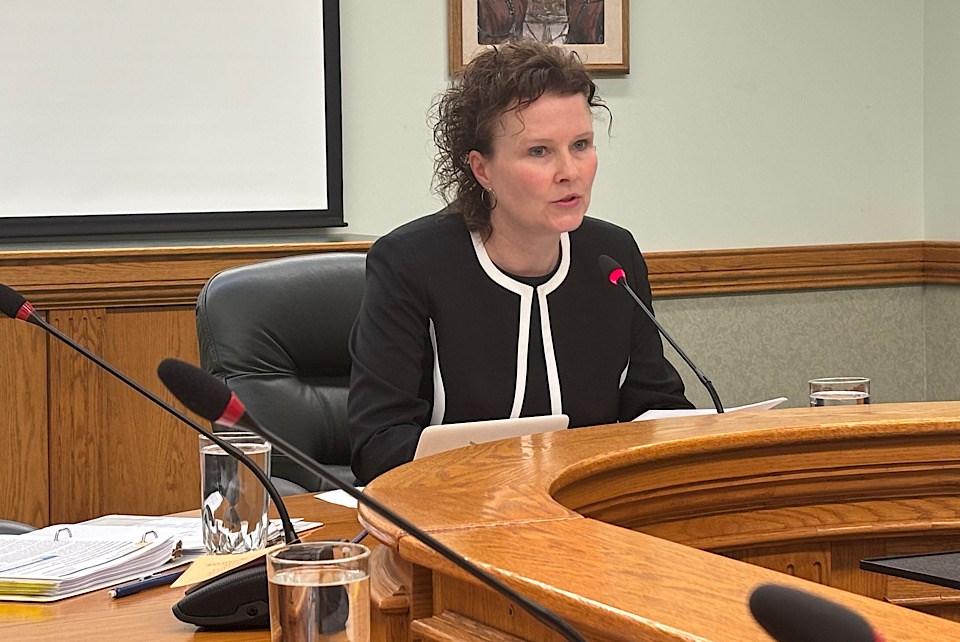
REGINA — Overreliance on contracted resources and a need for better planning were focuses of Provincial Auditor Tara Clemett’s audit of the Saskatchewan Public Safety Agency’s resource planning processes for wildfire response.
The provincial auditor made a number of recommendations in her 2026 Report — Volume 1, released on Tuesday, in connection to the SPSA. Clemett's report comes close on the heels of MNP's report into the SPSA's response during the 2025 wildfire season, which saw 11 recommendations issued.
In her report, Clemett focused primarily on costs. She said that in recent years, the frequency of wildfires had grown significantly. Clemett pointed out that during the 2025 wildfire season, 510 wildfires had burned three million hectares and had cost the agency $350 million in wildfire response.
“Effective wildfire response requires having the right personnel, equipment and supplies at the right time in the right place,” said Clemett at her news conference at the legislature in Regina.
She said the SPSA needs more robust wildfire resource plans and analysis, such as capital asset maintenance and replacement plans, targeted recruitment and retention plans for key staff such as aircraft maintenance engineers, and a clear identification of resources needed for wildfire response, like helicopters and firefighters.
Without strong planning, the agency risks entering each wildfire season “without an optimal level of resources, resulting in increased costs and reliance on contracted services,” said Clemett.
She noted that in 2025, 916 wildfire personnel and 12 aircraft were contracted from outside the province through mutual aid agreements to combat wildfires. She said that in 2025, the province spent approximately $26.3 million on contracted resources, and they found that the contracted personnel “cost two to five times more than Agency firefighters.”
Clemett said the agency also needs to “analyze the effectiveness of its wildfire resource use, including timeliness and cost-benefit of contracted resources like helicopters and personnel.”
She also said the SPSA neither assesses costs nor consistently tracks when contracted resources are requested and received. They found it took an average of 15 days for contracted personnel, such as firefighters, to arrive and deploy to fires in 2025.
Her office found that in 2025, short-term helicopter contracts averaged $3,400 an hour, or about 35 per cent more than the eight long-term contracts. Clemett said the SPSA could have saved around $500,000 by using an additional long-term helicopter contract for wildfire response.
Clemett also said the SPSA did not prepare its annual budget based on robust resource plans and needed to include all expected wildfire response costs.
“Actual variable costs related to wildfire response exceeded the Agency’s initial budget by more than $70 million in each of the last three years, showing budgets do not reasonably reflect expected costs of wildfire response each year.”
They also recommended the SPSA work with communities identified as having higher wildfire risk to make sure community wildfire preparedness plans exist.
“We found the Agency identified 89 northern communities as higher risk, but 21 of those communities did not have completed a wildfire preparedness plan.”
Clemett noted that at the end of each wildfire season, the SPSA has undertaken formal reviews to identify improvements. She recommends the agency formally monitor and report whether those have been addressed.
She said the SPSA should set and monitor an initial-attack success measure showing the extent of wildfires kept below 10 hectares in size, as this is a key indicator of effective wildfire suppression.
Clemett also noted the SPSA had an initial-attack success rate of 70 per cent in 2025 compared to 76 per cent in 2024.
“By basing budgets on robust resource plans, systematically tracking requested and received contracted resources, and evaluating resources actually used, the Saskatchewan Public Safety Agency can make sure it has the necessary resources to manage and mitigate the risks associated with wildfires and improve cost efficiency.”