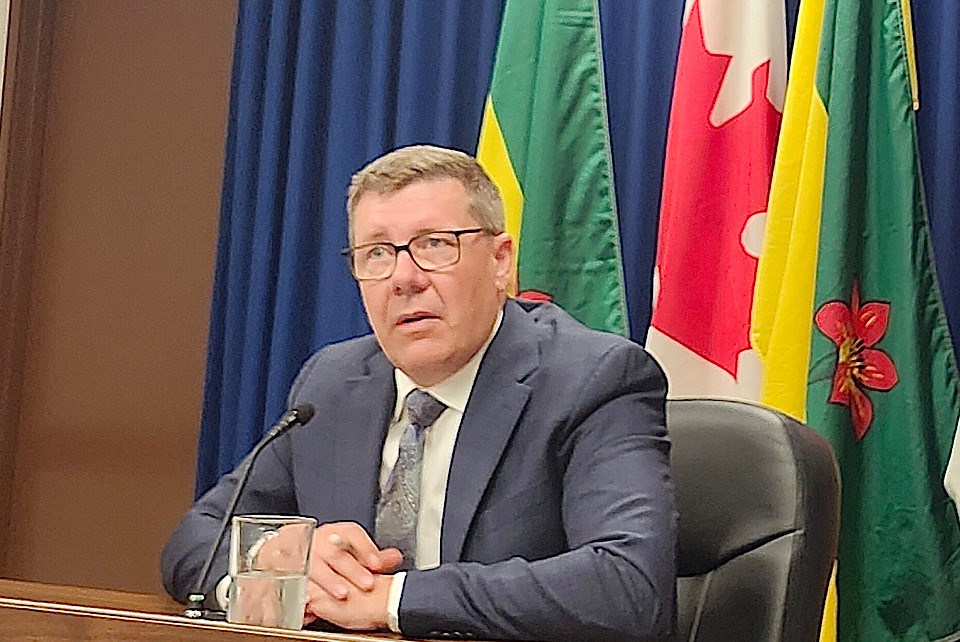
PRINCE ALBERT — Premier Scott Moe voiced optimism Wednesday about the trade deal in the works between Canada and the U.S.
Speaking to reporters in Prince Albert, Moe welcomed the “agreement in principle” reached the previous evening and welcomed the fact that the threatened 50 per cent tariffs on $28 billion in Canadian goods, which were set to be imposed on Aug. 19, had been paused until Aug. 21 while negotiations continue.
“That is not coming into effect, and that, I think, is step one, and that is a positive step in the negotiations that have been occurring up to and including last night and still going on as we speak,” Moe said.
Moe also said the federal government continues to “negotiate potential reductions to existing sectoral tariffs that we have.” He called it “incredibly important to industries in Saskatchewan and, I would say, more broadly to industries across Canada.”
A third point Moe made, which he called “specifically beneficial, I think, to Western Canada, but indirectly beneficial to all Canadians,” was the “notional intention to expand our relationship when it comes to trading energy, whether it be oil, whether it be uranium, or whether it be any other energy sources that are coming into production and construction, specifically in our province. And that also, I would say, is very much a positive.”
Moe also cautioned that the CUSMA deal that the country had one and two years ago was “no longer possible, and so we have to go to the negotiating table as Canadians, and we support those negotiations that have happened as a province of Saskatchewan, and continue to happen, to get the best deal that we can possibly get.”
Moe cited the need to have “preferred market access to our largest market and our largest trading partner, the United States of America, and I feel that is what we are in the process of achieving, which is a best-in-class trade agreement.”
Moe said Canada will “have the strongest trade agreement of any country in the world with the United States of America.”
“But we also need to understand that the status quo that we had two years ago was not possible. It was not on. And we have to find, and the federal government needs to find, the best path forward so that we can retain industries that are currently employing Canadians, wherever they might be,” Moe said, pointing specifically in Saskatchewan to the energy, mining, value-added agriculture and manufacturing industries.
Moe gave credit to federal minister Dominic LeBlanc, Ambassador Mark Wiseman, lead trade negotiator Jean Charest and Prime Minister Mark Carney for “finding us that path.”
He said there was more work to do in the near term and in the next number of months with respect to CUSMA, but Moe said Canada was “in a much better place than we were even 24 or 48 hours ago with respect to finding certainty and providing certainty for Saskatchewan and Canadian businesses, and ultimately providing certainty for Canadian families, including those that live in this province.”
On Wednesday, Moe participated in a first ministers' conference call with Prime Minister Carney and the other premiers to discuss the ongoing trade negotiations with the United States.
According to a statement from the Prime Minister’s Office, Carney “underscored the importance of a strong Team Canada approach, emphasizing continued collaboration with provincial and territorial governments as the federal government works to finalize a deal with the United States.” The statement said Carney had reiterated that the “government’s goal is to secure the best deal for Canadians — one that provides the greatest possible U.S. market access for Canadian businesses.”
One question that has been raised is whether American liquor would go back on the shelves at Canadian liquor stores and whether the individual provinces would go along with that move.
Moe confirmed there is a request from Carney to the provinces as “part of this arrangement regarding some of the procurement practices, specifically those with U.S. alcohol on the shelves, which doesn’t impact Saskatchewan or Alberta — we’ve allowed consumers to make their own choice all along — but there will be an ask by the Prime Minister for other provinces to make a decision in that space for this to move forward.”
As for whether provinces will be unified in their response, Moe said there has “always been an overarching effort” among all the provinces, and that “we can set aside our differences in the best interests of the nation.”
“That diversity certainly isn’t a weakness. It is a strength, and it always has been a strength for us to respect one another’s diversity. But there is an initiative, a broad goal of all the premiers, to put our nation first, to ensure that we are doing what we can to find our way — in this case, to a trade agreement of some type that gives us preferred market access … with our partner in the United States of America.”
As for how confident he was that a deal would last, Moe acknowledged that if the U.S. were to move away from this deal in a month, three months or six months, it would be “beyond the control of myself or Prime Minister Carney or anyone in Canada, for that matter.”
“What we can do is, in good faith, make our best efforts to come to an agreement to provide certainty for the industries and, more importantly, the families that work in those industries across the nation.
“There are some very real impacts, and we've seen that in certain industries here, not too far from right here in Prince Albert, Saskatchewan, but we've seen some significant impacts across the nation as well. And so it is incumbent on the federal government, and I feel they have taken up this challenge through quite intensive negotiations, in particular over the last few weeks, to find a path forward. Where it goes from here would obviously be the decision of those two partners, but we need to bargain in good faith, and I feel that Canadians believe that our government and our negotiating team are.”
As for comments from President Donald Trump saying this deal is very good for farmers in the United States, Moe noted the government has always said that tariffs are “detrimental to not only Canadian industries and families, but also very detrimental to American industries and families, and they really do strike at the very heart of our North American economic competitiveness.”
Moe believed that if there are changes in tariffs that might be positive for American farmers, “I would say that equally that would be positive for Canadian farmers as well. I've often shared the story of how integrated our ag economy is. We buy tractors and combines from the U.S. They often will buy drills and plant genetics and potash fertilizer from Saskatchewan. Any time that we can make our ag industry, whether it be south or north of the 49th parallel, more competitive, it's going to be good for farmers on both sides of that border.”
Moe also welcomed comments from Trump that this deal could revive the Keystone XL pipeline. Moe said he has “always been positive on any additional pipeline access, not only to the American market, but to the West Coast, so that we can access the rest of the world as well.”