


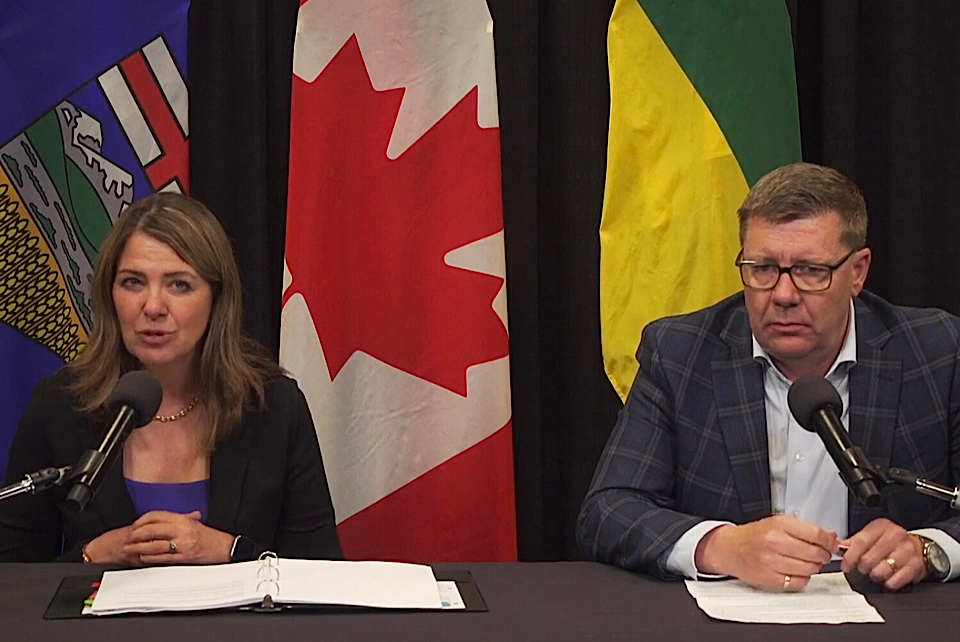
REGINA, Sask. — We examine the national unity boost following Alberta's decisive referendum vote, track Ottawa's threat to force the sale of Stelco's Canadian assets, hear from Saskatchewan Premier Scott Moe and Alberta Premier Danielle Smith on strengthening east-west trade, and review Manitoba's efforts to redirect agricultural exports to Asian markets.
Podcasts are available now on GX94, Yorkton, or on 620 CKRM, Regina, hosted by Steven Wilson. Or read the transcript below:
Steven Wilson — Welcome to Trade Dispute: Impact on the Prairies. I'm Steven Wilson.
The cross-border trade dispute has officially landed in an American courtroom.
A lawsuit challenging U.S. President Donald Trump's 50 per cent tariffs on certain Canadian goods was filed yesterday in the U.S. Court of International Trade.
The legal challenge was brought forward by Gellert Global Group, a major food importer that brings Canadian cheese into the United States and exports American food products to international markets, leaving the company exposed to cross-border trade restrictions.
The lawsuit argues that the president's use of Section 338 of the Tariff Act of 1930, a Depression-era statute, exceeds his legal authority.
At the same time, the Canadian federal government is escalating its fight with American corporate executives in the steel sector.
Industry Minister Mélanie Joly has warned that Cleveland-Cliffs could face significant financial penalties and a court-ordered sale of its Canadian assets under the Investment Canada Act.
The warning follows the Ohio-based company's decision to idle Stelco's galvanizing lines in Hamilton amid concerns about layoffs and its commitments to Canadian workers.
Legal questions remain over whether the company has complied with the conditions attached to its acquisition of Stelco, including commitments to maintain employment levels.
On the political front, the federal government is celebrating a major domestic victory.
Albertans went to the polls Monday and overwhelmingly rejected beginning the process of separation, with roughly 76 per cent voting against the proposal.
Prime Minister Mark Carney welcomed the result as a victory for national unity in the middle of a cross-border trade war, saying Albertans had made it clear they wanted to build a stronger Canada together.
Alberta Premier Danielle Smith pledged to honour the result and ruled out holding another referendum on independence during her tenure.
However, separatist leaders insist the movement is not going away.
Saskatchewan Premier Scott Moe welcomed the outcome, saying national unity is essential as Canada navigates the ongoing trade conflict.
Scott Moe — Yeah, I would say first I'm pleased to see that there's a strong message sent.
I think it was 76 per cent, or just north of 76 per cent, of Albertans that voted to remain in the nation of Canada.
And I would say that from Saskatchewan's perspective, we very much will continue to work with Premier Smith and all of those Albertans on contributing, doing what we can together to work together to contribute to not only stronger provinces, but stronger provinces within that broader, stronger nation of Canada.
Steven Wilson — Moe added that while Ottawa must continue to speed up approvals for major resource projects, Canada is well worth the effort to keep together.
That push for domestic unity is also changing the flow of Prairie commerce.
In an exclusive interview with Harvard Media, Alberta Premier Danielle Smith said the trade war has highlighted the need for provinces to remove internal trade barriers and develop east-west energy corridors.
Jon Tupper reports from Fort McMurray.
Jon Tupper — Alberta Premier Danielle Smith says growing trade uncertainty is pushing Canada to rethink how it moves energy and goods across the country.
In an exclusive interview with Harvard Media News, Smith pointed to U.S. President Donald Trump's decision to revisit the Canada-U.S. trade relationship and the ongoing uncertainty surrounding its future.
Danielle Smith — With the election of Donald Trump in the United States and the surprise of him wanting to revisit what we had thought was an established Canada-U.S. free trade agreement, I think that that got everyone thinking, my goodness, we all have our trade relationships north-south, why do we have such a hard time trading with each other east-west?
And then the final pillar, I think, was what happened with the closure of the Strait of Hormuz, and that impacted everybody else's energy supply.
And when you start seeing affordable energy becoming out of reach of regular people, and it's impacting everything from when you fill up your tank to buying groceries to heating and powering your home, that's when politicians have to pay attention.
Jon Tupper — Smith says global uncertainty is also increasing demand for reliable Canadian energy, creating new opportunities for Alberta producers.
Danielle Smith — In this world of uncertainty, where everyone is looking for a reliable supplier, the name on everyone's lips is Canada, and we finally have Canada and Alberta working together to make that happen.
Jon Tupper — Smith says improved federal and provincial cooperation is helping restore business confidence across the country.
In Fort McMurray, for CKRM News, I'm Jon Tupper.
Steven Wilson — While Alberta looks to strengthen domestic energy connections, Manitoba is facing a significant realignment of its export markets.
A new economic analysis by Dr. Dan Tingskow indicates Manitoba's exports to the United States are nearly $1 billion lower this year amid tariffs and ongoing trade disruptions.
With agricultural goods accounting for a significant share of the province's exports, Manitoba is accelerating efforts to strengthen alternative trade relationships with Japan, Mexico and South Korea.
South of the border, construction markets have received some relief.
The U.S. Department of Commerce published the results of an administrative review of Canadian softwood lumber duties yesterday, reducing certain rates.
Building associations in border states such as Montana and North Dakota welcomed the prospect of lower costs for contractors facing expensive building materials.
Tomorrow, we'll cross the 49th parallel to check in on the U.S. midterm election campaigns.
We'll feature an interview with Montana Democratic Senate candidate Alani Bankhead to hear what American voters are saying about the trade dispute.
I'm Steven Wilson. Thank you for listening to Trade Dispute: Impact on the Prairies.
Read more stories from your community and across the province at sasktoday.ca and 620ckrm.com.
Listen weekdays at 9 a.m. on 620 CKRM and GX94 for new installments of Trade Dispute: Impact on the Prairies.




