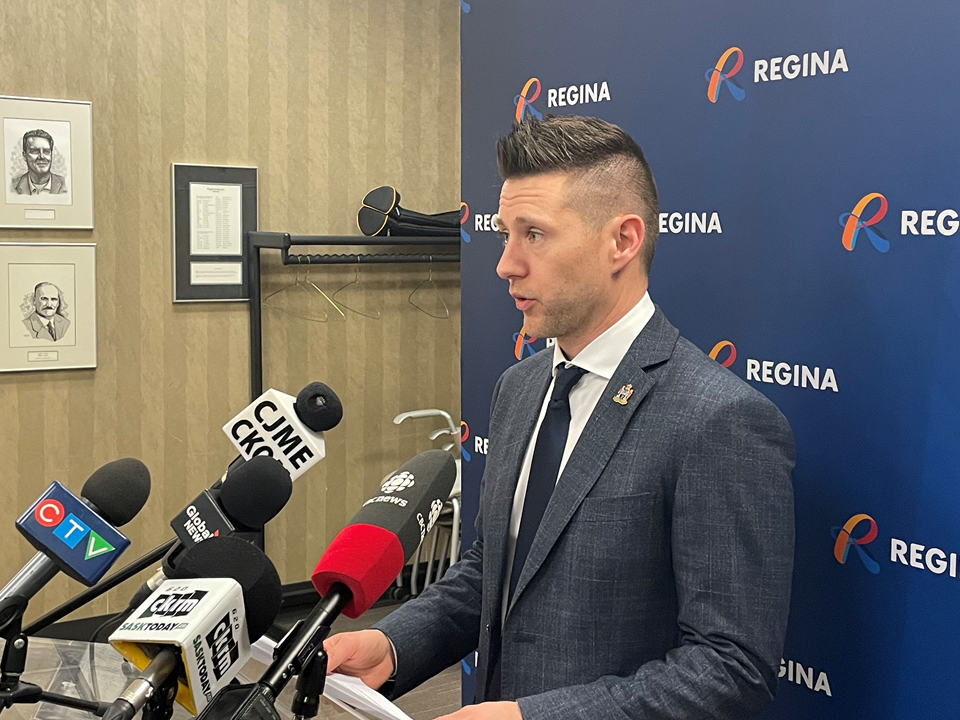
REGINA — Regina Mayor Chad Bachynski said he was pleased with the increase in Municipal Revenue Sharing (MRS) in the 2026 provincial budget.
The province is allocating $392.4 million into the program, a record amount and an overall increase of $30.7 million from last year.
“Hearing that there’s an 8.5 per cent increase was very good to hear that, especially given the model allows us as a municipality to leverage that money in the ways that we know we need to use it,” said Bachynski during a scrum inside the Saskatchewan Legislature on Wednesday.
The MRS model sees 0.75 of one full point for Provincial Sales Tax (PST) redistributed towards municipalities.
For Regina, Bachynski said the funds are important to play “catch-up” with aging infrastructure.
Although the additional funding is appreciated, Bachynski said Regina is always looking for more funding.
“We’re still going to be advocating and pushing for other types of agreements that are specific to some of those infrastructure investments. So some of the work that we’ve been doing in Ottawa, some of the work that we’ve done with the province to advocate for a tripartite agreement.”
In January, Regina city council pushed on behalf of the Saskatchewan Urban Municipalities Association (SUMA) for the province to explore alternative revenue sources for municipalities, including new or enhanced taxation options.
Council also advocated for exempting municipalities from PST on construction projects, reinstating municipal surcharges on natural gas and electricity, and for the provincial government to collect education tax once again or re-introduce a grant to cover the administrative burdens for municipalities.
Recently, Premier Scott Moe indicated that no changes would come to the model.
From his perspective, Bachynski said the city “is quite happy with the model.”
However, he admitted municipalities won’t be able to catch up on infrastructure from solely municipal taxpayers.
“We’ll continue working with this year to look year after year in terms of how we look at more models and more flexibility to municipalities to address the concerns that we’re going through.”
Along with infrastructure, Regina has been dealing with homelessness over the past few years.
In the provincial budget, Saskatchewan is investing $1.69 million in social services.
Bachynski is pleased with the funding, but admitted more investment is needed for transitional housing and supportive housing.
“That’s what’s gonna help get people through those challenges and into a stable place in their own lives.”
Bachynski also said investing more in mental health and addictions will help stop people from ending up in bad situations, including committing a crime.