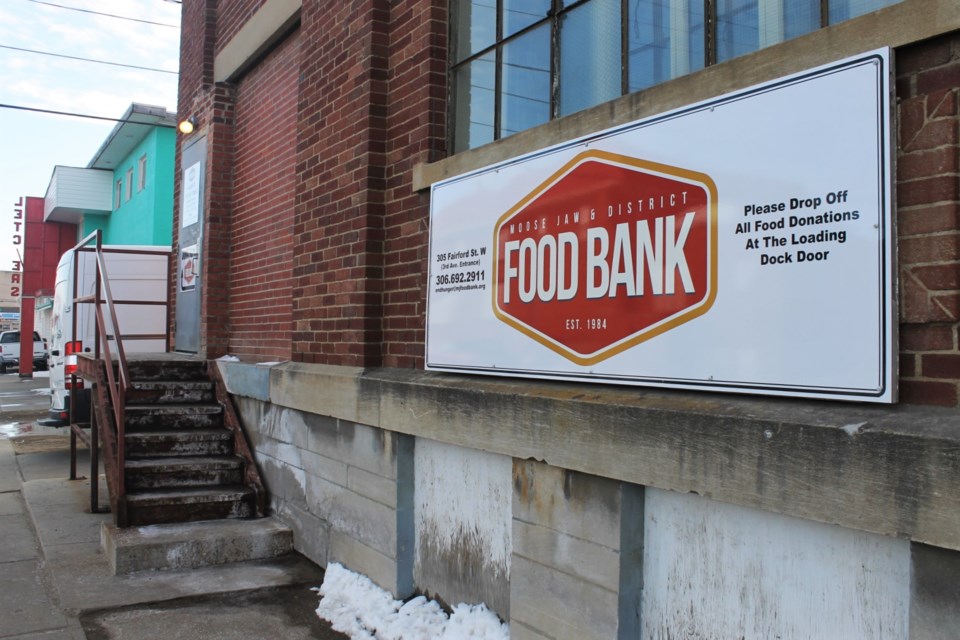
MOOSE JAW — As more residents struggle to afford basic needs, demand at the Moose Jaw and District Food Bank has jumped 150 per cent, forcing major service changes.
The food bank released a message to their patrons, donors and community members, March 24, sharing that the number of visits to the food bank has seen an increase of more than 150 per cent over the past four years. As a result of the growing needs within the city, the food bank will be implementing some major changes effective April 1.
Executive director, Jason Moore, said in a statement that more than 1,000 visitors are utilizing the food bank each month, with more than 50 new households seeking support for the first time.
“This is not unique to Moose Jaw. Food banks across Canada have been reporting similar trends. What we are experiencing locally is part of a much larger, provincial and national issue,” said Moore. He adds that many individuals and families are finding their income no longer stretches far enough to cover basic needs since the cost of living has risen sharply, and wages and income supports have not kept pace.
“We are seeing more seniors on fixed incomes, more working families, and more individuals who have never accessed a food bank before now needing support. For many, this is not a temporary situation, but an ongoing gap between income and the true cost of living,” continued Moore.
As usage continues to rise, there has been a significant decrease in monetary donations, almost 20 per cent less than last year. Moore also reminded everyone that all food banks are in place as a community safety net and were never designed to carry long-term high demand.
“When we look at this reality clearly, we are faced with a difficult truth. We can no longer sustain our current level of service in a way that meets the growing need.”
As of April 1, access to the Moose Jaw and District Food Bank will be by appointment only, with a limit of one visit per month instead of two, and on Wednesdays, the service will no longer be open in the evenings. Food quantities will also be adjusted to ensure sustainability, with staff reviewing and weighing carts at the end of each visit to ensure limits are followed.
Most food banks across Saskatchewan require identification for each family member to confirm household size and proof of residency in the community. In other urban centres such as Saskatoon and Regina, food bank hampers are available to qualifying households twice per month. Appointments are required in Regina, whereas no appointment is required to access the Saskatoon Food Bank.
Funding from Saskatchewan government cut
With the provincial budget, it became clear that the $1 million annual funding to Food Banks of Saskatchewan to help offset rising food costs and growing demands was not being renewed.
“This is unbelievable – at a time when Saskatchewan families are struggling more than ever to put food on the table, Scott Moe is turning his back on them,” said Saskatchewan NDP Leader Carla Beck. “Cutting support to food banks right now is not just shortsighted, it’s cruel and a direct blow to people already being stretched to their limits.”
According to the Official Opposition’s news release, while under the leadership of Scott Moe, Saskatchewan has seen food bank use increase by nearly 50 per cent. One-in-five users are employed and nearly four-in-10 are children — the highest rate in Canada, said NDP.
“Food banks are being pushed to the breaking point while this government piles more costs onto working families,” said Britney Senger, Shadow Minister for Community-Based Organizations. “Saskatchewan people deserve a government that makes life more affordable.”
In the Moose Jaw and District Food Bank’s announcement, Moore said he believes this situation is a moment for collective advocacy.
“We are calling on our community, and communities across the country to engage with and push for a stronger, more meaningful response from all levels of government. The current supports in place are not aligned with the realities people are facing, and the burden placed on individuals, families and community organizations has become unsustainable.
“This is a time to stand up, speak out, and ensure that the voices of our communities are heard. The situation has reached a level that demands urgent and meaningful action. We share this message not only to inform, but to invite understanding. The need we are seeing here is real, and it is growing, but it is not ours alone. It is being felt across the country,” continued Moore.
Residents of Moose Jaw shared their support for the city’s food bank, commenting that the announcement should be sent to the local MLA’s office and the prime minister’s office.
One man shared a copy of an email he sent to various government officials, starting with the quote, “The moral character of a nation is frequently judged by how it treats its most vulnerable, weakest and poorest members rather than its wealthy or powerful citizens.” He continued to say, “It is tiring reading or hearing our leaders tell us how great everything is because a handful of people are making lots of money. The fact that some corporations made billions in profits has no bearing on most of us.”
After explaining the Moose Jaw and District Food Bank’s situation, he asks “How do you explain it in simple terms to us simple folk on how this is good for anyone? Tell us again how great Saskatchewan is doing, please, if not, then all levels of government should be working together to help resolve this food insecurity crisis.”
When asked why the food bank funding was cut, the Ministry of Social Services said, “The Government of Saskatchewan provided $2 million in funding to Food Banks Saskatchewan, fulfilling the two-year commitment announced in July 2024. This year’s budget provides targeted increases in other areas to help make the costs of daily life more affordable, including:
- Increasing Saskatchewan Income Support (SIS) and Saskatchewan Assured Income for Disability (SAID) core benefits by two per cent;
- Increasing monthly Saskatchewan Housing Benefit (SHB) rates to help eligible renters better afford their rent and utility costs and expand the program to over 300 new clients;
- Increasing SAID residential support benefits for families that care for their loved ones at home by 30 per cent over the next three years (10 per cent each year); and,
- Exempting the new federal Canada Groceries and Essential Benefit from income assistance programs."
Following news that Manitoba is considering removing PST from all grocery items, Finance Minister Jim Reiter said few grocery products in Saskatchewan are subject to PST and that the province is taking a different approach.
He said the government is focusing on broader affordability measures, including programs such as the active families benefit and graduate retention program, as well as income tax reductions aimed at allowing residents to keep more of their earnings.
“We’ve made huge decreases in income tax, as you hear the premier say in the legislature [recently]. Income tax is far more affordable in Saskatchewan than it is in Manitoba.”
Although the Moose Jaw and District Food Bank said their hands may feel tied in this moment, the commitment to the work and the people they serve will not change.
“We will continue to do everything we can, with what we have, for as long as we can.”