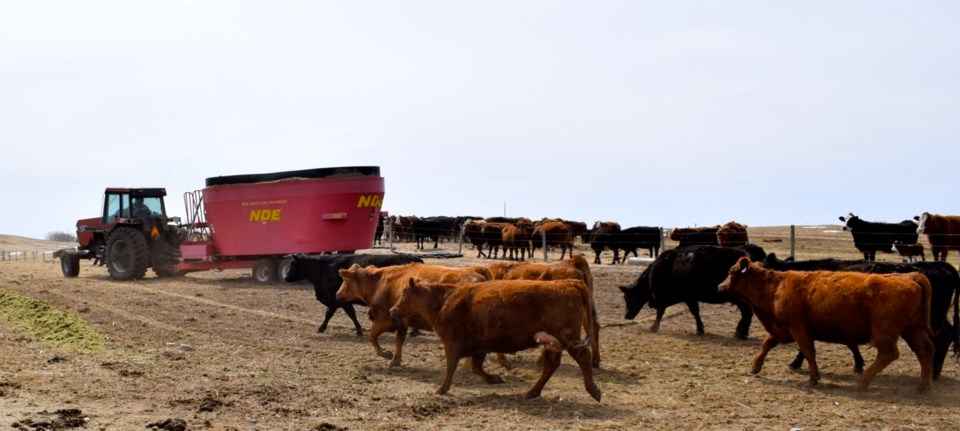
MOOSE JAW — Saskatchewan cattle producers are grappling with trade uncertainty, shrinking herd numbers and proposed new regulations, and the Saskatchewan Cattle Association says it is working on multiple fronts to protect the industry.
With 16 board members representing districts across the province and operating as a producer-funded organization, the Saskatchewan Cattle Association has been busy dealing with trade and traceability issues.
Canadian beef trade with China, the current Canada-United States-Mexico (CUSMA) agreement that is up for renewal this year, and recent issues with the Canadian Food Inspection Agency (CFIA) have Chad Ross — a rancher and current chair of the Saskatchewan Cattle Association — and the rest of the SCA advocating on producers' behalf.
Ross said the association represents 18,000 cattle producers in the province and "we look after the advocacy and we look after communications to our consumers. We also look at a lot of research and then part of that funding goes after national communications as well as national marketing. National marketing, national research, national advocacy- all on our producer's behalf."
The beef industry has managed to finally return to trade with China after a five-year ban.
This also has producers hoping to see China return as the fourth-largest importer of Canadian beef. While this does mark an uptake in sales, Ross states that producers are also mindful of other markets.
"We have to export fifty per cent of what we produce here in Canada. So, no matter where it goes, opening export markets is very important and very advantageous. When we last exported to China I think we were in the $300-million range of exports."
While the Chinese market will help in sales, it will largely involve products western consumers do not eat in large quantities. The SCA chair states, "China tends to eat the things we don't want to eat so it adds value to our animals being able to export those pieces and parts that aren't normally on the Canadian menu, so it really adds value to our production."
As Canadian trade looks to diversify, he reminds consumers that currently "seventy per cent of our exports are going to the United States so you know they are very important to us" with Japan, Mexico and South Korea being other main trading partners.
As the current CUSMA deal is up for renewal this year, Ross and other members of the cattle industry will be closely watching the results. While volatility in the U.S. beef trade industry is already occurring, along with tariff threats that surfaced about a year ago, Ross reminds consumers the two sides are still very integrated and "it benefits both sides" when cattle flow across the border to fill demand.
The SCA has also been busy lobbying on behalf of Canadian producers "to make sure the North American beef industry stays intact," including making a recent trip to Nashville's CattleCon.
While the upcoming negotiation with CUSMA is just one of the issues to be dealt with, another is trying to maintain cattle deals amid a smaller animal supply.
Not since the 1950s, Ross says, have cattle numbers been this low while in an expansion phase. This leads competitors such as Argentina and the United States to take advantage and trade among themselves.
Current Canadian producers are more likely to take a longer-term view, with "producers hanging onto cows and maybe breeding more and as a result we have less culled cows going into the system. That means we have less trim and that is the hamburger- with a huge demand for trim.
Fifty per cent of what Canadians and Americans eat is ground beef. The product coming in from Argentina is ground beef, so that it's helping consumers that maybe it isn't as pricey as our domestics and keeps them eating beef." He considers it a short-term positive.
And finally, with the high quality of beef, "and makes for a very tasty product" and 50 per cent of what we produce is consumed right here at home and we are grateful for the demand that we have for our product and they are realizing the health benefits of it and that it is a high quality product."
With high quality and demand also come high standards — with the CFIA currently the major thorn in the side of the cattle industry.
The CFIA, Ross stated, "has announced some proposed regulations regarding traceability", in December 2025. However, it is currently at a stoppage, with the SCA being one of the first to ask to halt these proposed regulations.
"Traceability is not new -been around for close to 20 years", Ross mentions. "Our association has been trying to make sure regulations are not complicated, not onerous, or financially burdensome for our producers. We feel these regulations are in some sense burdensome."
With a variety of new detailed changes regarding traceability still on the CFIA website, the main goals to halt these vary. Ross mentions a few, including technology and cost, that need to be examined.
Stating there has to be government programs to help with the cost of new requirements, and citing a major need to reform the CFIA, Ross comments that "the big issues is that our producers have lost faith and trust in the CFIA. We need to incentivize, not criminalize our producers in these investigations. Work with our industry and we aren't seeing that at this time. We would like to see that the CFIA move from the Department of Health to under Agriculture and Ag. Food Canada."